Plastic folding table prices vary widely because a retail price, a wholesale price and a factory quotation are not the same thing.
For individual buyers, a standard plastic folding table may cost anywhere from around $40 to more than $150 at retail, depending on the size, brand, construction and features. Larger 8ft tables, round banquet tables and commercial-grade models can cost considerably more.
For distributors, wholesalers, event rental companies and other bulk buyers, the unit price is usually much lower than retail—but there is no meaningful “one price” for a factory order.
A factory quotation depends on factors such as:
- table size and structure,
- HDPE tabletop weight and material,
- steel frame specification,
- folding mechanism,
- order quantity,
- packaging,
- branding or customization,
- container loading efficiency,
- and the agreed trade term.
That means a $1 difference in the factory price does not necessarily mean one supplier offers a cheaper product overall.
For an importer, the better question is:
What specification am I getting, and what will each table actually cost after production, packaging and shipping?
This guide explains how plastic folding table pricing works and what bulk buyers should compare before placing an order.
Plastic Folding Table Prices at a Glance
The following ranges are useful as a general retail reference rather than a factory price list.
| Table Type | Typical Retail Reference | Main Factory Cost Drivers |
|---|---|---|
| 4ft rectangular folding table | Approx. $40–$90+ | Tabletop weight, width, fold-in-half design, packaging |
| 6ft rectangular folding table | Approx. $40–$150+ | HDPE usage, frame specification, tabletop structure, quantity |
| 8ft rectangular folding table | Approx. $70–$160+ | Material consumption, reinforcement, folded size, loading volume |
| 48–60in round table | Often $100–$250+ | Diameter, frame design, tabletop weight, commercial grade |
| 72in round banquet table | Often higher | Larger mold, material usage, reinforcement, shipping volume |
| Square plastic folding table | Varies widely by size | Dimensions, tabletop structure, frame, packaging |
Retail prices change frequently depending on the country, sales channel, promotion and brand, so they should not be used as a direct benchmark for a Chinese factory quotation.
If you are still deciding which table dimensions are suitable for your market, start with our folding table size guide before comparing prices.
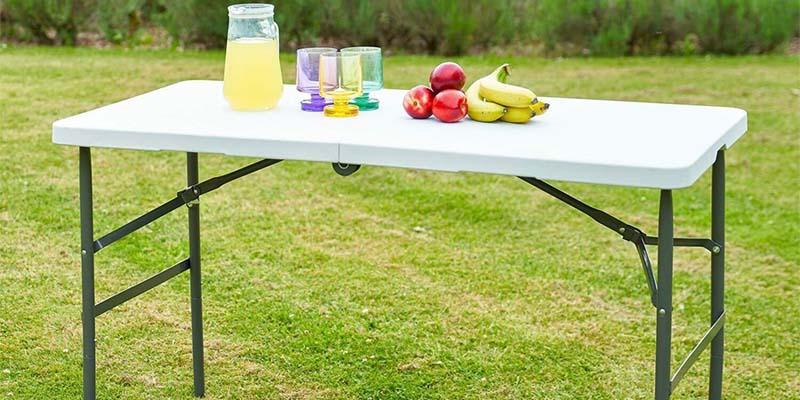
Retail Price vs. Factory Wholesale Price
One of the most common pricing mistakes is comparing a factory quote directly with a retail selling price.
They represent completely different stages of the supply chain.
| Retail Purchase | Factory Wholesale Purchase | |
|---|---|---|
| Typical quantity | 1–10 pcs | Hundreds or container quantities |
| Price basis | Final consumer selling price | Factory, EXW, FOB or other trade quotation |
| Product choice | Existing models | Existing models + OEM options |
| Branding | Usually fixed | Logo, color and packaging may be customized |
| Packaging | Consumer-ready | Export, retail or e-commerce packaging |
| Freight | Parcel/local delivery | Sea freight, container or commercial shipment |
| Buyer | Consumer | Distributor, wholesaler, retailer, rental company |
| Main cost focus | Price per table | Total landed cost and margin |
A retail price usually includes costs that occur after the table leaves the factory, such as importer margin, warehouse costs, distributor margin, retail markup, domestic transport and marketing.
Factory pricing starts much earlier in the supply chain.
This is why businesses looking for hundreds or thousands of tables should compare manufacturers rather than use consumer retail prices as their primary sourcing benchmark.
For buyers ready to compare actual products rather than general market information, see Byliable’s plastic folding table factory pricing page.
Plastic Folding Table Price by Size
Size is one of the easiest price differences to understand: larger tables normally require more plastic, a larger frame and more shipping volume.
But size alone does not determine cost.
Two 6ft tables can have the same outside dimensions and still have very different factory prices.
4ft Plastic Folding Table Price
A 4ft folding table generally requires less material than a 6ft or 8ft model, making it one of the more economical rectangular options.
However, several designs fall under the “4ft table” category.
A simple folding-leg table may have a different cost from a fold-in-half model with:
- a center hinge,
- locking mechanism,
- carrying handle,
- reinforced frame,
- and individual retail packaging.
For distributors and e-commerce sellers, the folded dimensions can also be important because a compact fold-in-half structure may reduce storage space and make parcel or warehouse handling easier.
6ft Plastic Folding Table Price
The 6ft format is one of the most widely used plastic folding table sizes for:
- event rental,
- catering,
- banquet use,
- schools,
- churches,
- conferences,
- retail,
- and general commercial use.
Because the market for 6ft tables is highly competitive, buyers often receive quotations that look very similar at first.
This makes specification comparison especially important.
A lower-priced 6ft model may use:
- less HDPE,
- a lighter tabletop,
- thinner steel tubing,
- a simpler locking system,
- lower-cost packaging,
- or different raw material.
Before comparing quotations, review the actual specification of the 6ft folding tables being offered.
8ft Plastic Folding Table Price
An 8ft table normally costs more to manufacture than a comparable 6ft model because it uses more material and requires a structure capable of supporting a longer tabletop.
Transport also becomes more important.
An 8ft table or carton occupies more space, which can reduce the number of units loaded into a container.
As a result, buyers should compare:
factory price per table + loading quantity + freight per unit
rather than looking only at the purchase price.
You can compare typical product structures on the 8ft folding table range.

Round Plastic Folding Table Price
Round folding tables are especially common in:
- hotels,
- wedding venues,
- banquet halls,
- restaurants,
- event rental companies,
- and catering businesses.
The price generally rises as the diameter increases.
A 60in or 72in round table requires a larger tabletop, more material and a frame designed to distribute load evenly across the round surface.
Large round tables can also be less space-efficient during shipping than rectangular folding models.
For this reason, container loading should be considered before choosing a round table solely on unit price.
See Byliable’s round folding table options for commonly used commercial sizes.

Square Plastic Folding Table Price
Square folding tables are usually smaller and easier to handle, but their price still depends heavily on size, tabletop thickness, frame design and folding structure.
They are commonly purchased for:
- dining,
- cafés,
- training rooms,
- games,
- schools,
- retail,
- and small commercial events.
Buyers interested in this format can compare the available square folding table models.
What Determines the Factory Price of a Plastic Folding Table?
If two tables look almost identical in a product image but have noticeably different quotations, there is usually a reason.
The following factors have the biggest effect on factory cost.
1. HDPE Material and Tabletop Weight
The plastic tabletop accounts for a significant portion of the material cost of most blow-molded folding tables.
Commercial plastic folding tables are commonly made using high-density polyethylene, or HDPE.
However, the words “HDPE table” do not tell you everything about the specification.
Buyers should confirm:
- tabletop net weight,
- overall product weight,
- material composition,
- wall thickness,
- reinforcement design,
- and whether virgin, mixed or recycled material is used.
A lighter table may be cheaper and easier to ship, which can be an advantage in some markets.
But reducing material too aggressively can also affect stiffness, durability and long-term performance.
The correct specification therefore depends on the sales channel and application rather than simply choosing the heaviest or cheapest table available.
2. Virgin HDPE vs. Recycled Material
Raw material choice can create a significant price difference between suppliers.
Virgin or new HDPE generally costs more than lower-grade recycled or mixed material.
For buyers selling into markets where appearance, color consistency and repeated commercial use matter, material selection deserves careful attention.
Lower-priced tables are not automatically poor quality, but buyers should know what material is included in the quotation.
Instead of asking only:
“Is this an HDPE folding table?”
ask:
“What material composition and product weight are included in this price?”
That creates a much more useful supplier comparison.
3. Steel Frame Specification
The tabletop is only half the table.
Most plastic folding tables use a steel support frame, and the steel specification has a direct effect on both price and durability.
Important details include:
- steel tube diameter,
- wall thickness,
- leg structure,
- welding,
- reinforcement,
- powder coating,
- anti-rust treatment,
- locking components,
- and foot caps.
A table designed for occasional residential use does not require the same frame specification as a table used every weekend by an event rental company.
For commercial orders, ask suppliers to provide the frame specification instead of comparing appearance alone.
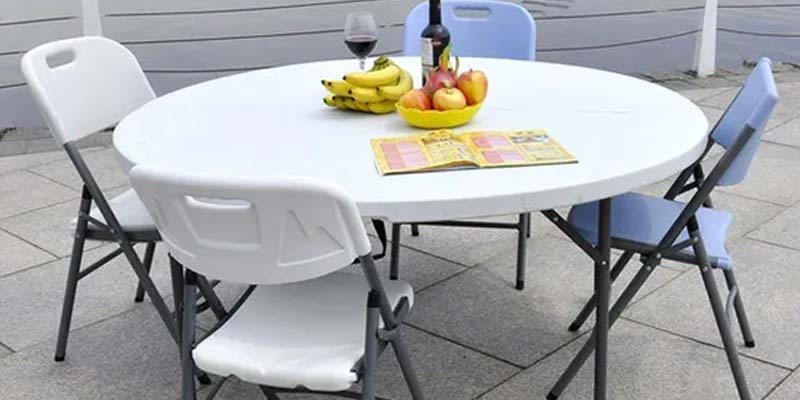
4. Folding Mechanism
A standard folding-leg table and a fold-in-half table may have the same open size but different production costs.
A fold-in-half design normally requires additional components such as:
- central hinges,
- locking hardware,
- carrying handles,
- reinforcing structures,
- and additional assembly steps.
These features add cost, but they can also improve portability and storage.
For e-commerce and consumer retail channels, that extra cost may be justified because a more compact folded package can improve the customer experience.
For banquet or rental use, a simpler full-length tabletop may sometimes be more practical.
5. Table Size and Product Weight
Larger tables normally use more raw material.
But total product weight is often a better comparison metric than nominal table length.
For example, two suppliers may both quote a “6ft HDPE folding table.”
One table may be considerably lighter than the other.
That difference may come from:
- tabletop thickness,
- internal reinforcement,
- frame weight,
- hardware,
- or material selection.
When comparing quotations, ask for both:
product dimensions and net weight.
That makes it much easier to understand why prices differ.
6. Order Quantity
Factory pricing is closely tied to production quantity.
A factory needs to consider:
- material preparation,
- production scheduling,
- machine setup,
- color changes,
- printing,
- packaging,
- and warehouse handling.
As volume increases, these fixed costs can often be spread across more units.
This is why a full production order generally has a lower unit cost than a small trial batch.
Byliable currently supports OEM/ODM bulk orders and lists a standard MOQ of 500 pieces for its product range.
For custom colors, packaging or specifications, the practical MOQ may depend on the project.
Need a more accurate factory estimate?
7. OEM Branding and Customization
Customization affects cost differently depending on what the buyer wants to change.
Simple customization may include:
- logo printing,
- tabletop color,
- frame color,
- labels,
- barcode,
- or carton printing.
More complex projects may involve:
- new table dimensions,
- structural changes,
- new molds,
- accessories,
- or entirely new product development.
Changing a logo is not the same as opening a new mold, so buyers should not treat all OEM projects as having the same cost impact.
If standard products already meet the market requirement, using an existing size and structure is normally the most economical approach.
8. Packaging
Packaging is one of the most overlooked parts of folding table pricing.
A supplier may quote a low unit price while using very basic packaging.
Another quote may include:
- individual export cartons,
- reinforced corner protection,
- retail printing,
- barcode labels,
- instruction sheets,
- mail-order packaging,
- or pallet requirements.
For e-commerce, packaging quality can influence damage rates and customer complaints.
For wholesale distribution, simpler export packaging may reduce unnecessary cost.
Buyers should therefore compare quotations using the same packaging requirement.
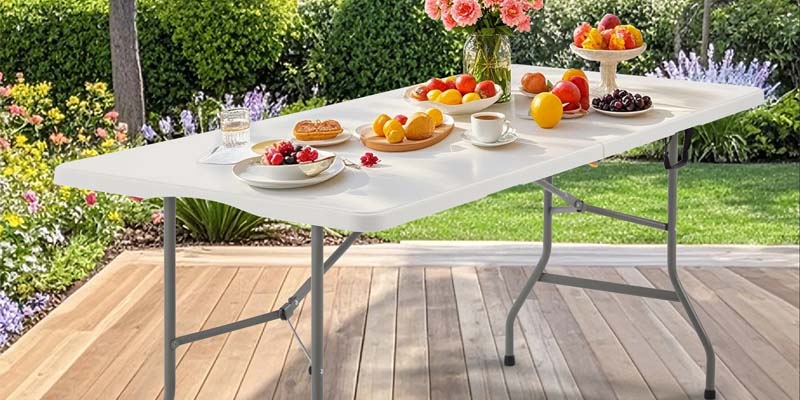
Why Container Loading Can Matter More Than a $1 Price Difference
Folding tables are relatively bulky products.
For container orders, freight cost is spread across the number of tables that can be loaded.
Consider a simplified example.
Supplier A offers a table for:
$1 less per unit
but its package is larger.
Supplier B has a slightly higher factory price but can load significantly more tables into the same 40HQ container.
Depending on ocean freight rates, Supplier B may ultimately provide the lower landed cost per table.
This is why professional buyers should request:
- product size,
- folded size,
- carton size,
- gross weight,
- packing quantity,
- 20GP loading quantity,
- 40GP loading quantity,
- and 40HQ loading quantity.
The lowest unit quotation is not always the lowest-cost sourcing option.
For a more complete purchasing checklist, read our guide on how to buy folding tables in bulk from China.
Factory Price vs. Landed Cost
Another important distinction is the difference between a supplier quotation and the final cost of importing the product.
The landed cost is the total cost of having the goods arrive at the buyer’s destination.
Depending on the trade arrangement, it may include:
Product cost
Export and local handling
Ocean or air freight
Insurance
Import duties and taxes
Destination fees
Local transportation
The U.S. International Trade Administration defines landed cost as the total cost of a product after accounting for price, insurance, freight, tariffs, taxes, and other fees. U.S. International Trade Administration — Landed Cost Guidance
This means purchasing decisions should not be made using EXW or factory unit price alone.
EXW, FOB, CIF and DDP: Why the Trade Term Changes the Price
A quotation also needs a clearly defined trade term.
For example, a supplier quoting EXW and another quoting FOB are not necessarily offering different product prices—the quotations simply include different responsibilities and costs.
The International Chamber of Commerce’s Incoterms® rules are the internationally recognized framework used to define many of these buyer and seller responsibilities. International Chamber of Commerce — Incoterms® Rules
Common terms buyers may encounter include:
EXW
The buyer takes responsibility relatively early in the shipment process, beginning from the agreed place of delivery.
FOB
The quotation includes certain export and shipment responsibilities to the agreed port and vessel delivery point.
CIF
The seller’s responsibilities include specified cost, insurance and freight arrangements to the named destination port.
DDP
The seller takes on considerably more responsibility for delivering the goods to the agreed destination.
The exact commercial responsibilities should always be confirmed in the quotation and sales contract.
When comparing supplier prices, make sure all suppliers are quoting on the same trade term.
Otherwise, the price comparison is misleading.
How Bulk Buyers Can Reduce Plastic Folding Table Cost
Reducing sourcing cost does not always require buying a lower-quality table.
There are several practical ways buyers can improve total cost without weakening the product.
Use Existing Standard Sizes
If a 4ft, 6ft or 8ft model already meets the market requirement, using an existing mold avoids unnecessary product development cost.
Byliable’s long folding table range covers several of the most common rectangular sizes.
Consolidate Order Volume
Splitting one annual requirement into many very small orders can increase per-unit production, handling and shipping cost.
Where cash flow and inventory allow, larger production runs can improve purchasing efficiency.
Optimize Packaging
Do not pay for premium retail packaging if the product will be unpacked immediately by a rental company.
At the same time, do not use basic export packaging for an e-commerce product that must survive parcel distribution.
The cheapest packaging is the packaging that is appropriate for the sales channel.
Compare Container Utilization
Ask every supplier for carton dimensions and loading quantity.
This gives you a more accurate freight cost per table.
Avoid Over-Specifying the Product
A table designed for light household use does not necessarily need the same specification as a commercial banquet table used hundreds of times.
Define the target application first, then select the appropriate material and frame configuration.
Prepare a Complete RFQ
Factories can quote faster and more accurately when the buyer provides a complete request.
Instead of writing:
“Please send your best price for 6ft table.”
provide:
- product or reference image,
- required size,
- estimated quantity,
- target weight or specification,
- color,
- logo requirement,
- packaging,
- destination,
- and preferred trade term.
This reduces repeated quotation changes and makes different supplier offers easier to compare.
Why Buy Plastic Folding Tables Directly from a Manufacturer?
Direct factory sourcing becomes particularly useful when buyers need:
- stable repeat orders,
- private-label products,
- customized colors,
- custom packaging,
- mixed folding table sizes,
- production planning,
- quality control,
- or container shipments.
Byliable is a China-based folding table manufacturer producing plastic folding tables for wholesale and commercial buyers.
Rather than treating price as a standalone number, a manufacturer can help buyers evaluate how the table specification, packaging and shipping arrangement affect the final cost.
This is especially useful for distributors and importers comparing suppliers across different product specifications.
Frequently Asked Questions
How much does a plastic folding table cost?
For individual retail purchases, common plastic folding tables can range from roughly $40 to more than $150, while large round or heavy-duty commercial models can cost substantially more. Factory wholesale prices for bulk orders are lower per unit but depend on specification, order quantity, packaging and trade terms.
How much does a 6ft plastic folding table cost?
Retail prices for 6ft plastic folding tables vary widely by brand and construction. For factory orders, a 6ft table should be quoted according to tabletop weight, HDPE specification, steel frame, folding structure, quantity and packaging rather than using one fixed online price.
Are wholesale plastic folding tables cheaper than retail?
Generally, yes. Bulk factory orders avoid some of the distribution and retail markup included in consumer prices. However, importers still need to account for packaging, freight, duties, taxes and destination costs when calculating the final landed cost.
Why can two 6ft folding tables have very different prices?
Two tables can share the same dimensions but differ in tabletop weight, material composition, steel tube thickness, locking system, product weight, packaging and production quality. These differences can create substantial price variation.
Does table weight affect price?
Usually. A heavier table often contains more material, although weight alone does not determine quality. Buyers should compare weight together with tabletop structure, HDPE specification and frame design.
Does a fold-in-half table cost more?
It can. Fold-in-half tables normally require additional hinges, locking components, handles and assembly. However, their smaller folded size may improve storage and transportation efficiency.
What is the MOQ for wholesale folding tables?
MOQ depends on the manufacturer, model and customization. Byliable currently lists a standard MOQ of 500 pieces for OEM/ODM products. Custom colors, packaging or special specifications may require different quantities.
Get a Plastic Folding Table Quote
There is no useful factory price without a clear specification.
A low quotation may represent a lighter table, different material, simpler packaging or a different trade term. Before choosing a supplier, compare what is actually included in the offer and calculate the likely landed cost.
Byliable supplies plastic folding tables for distributors, wholesalers, retailers, event rental businesses and commercial buyers.
If you need standard or customized tables, contact Byliable with your:
required table size
estimated quantity
target market
packaging requirements
destination country or port
and any OEM requirements.
We can then recommend suitable models and prepare a project-specific quotation.